“Life here tests the human spirit, but Montanans have found ways to express their relationship with the land. Something in Montana’s landscape nudges, pushes, and even shoves the creative spirit.”
— E.L. Kittredge

“Life here tests the human spirit, but Montanans have found ways to express their relationship with the land. Something in Montana’s landscape nudges, pushes, and even shoves the creative spirit.”
— E.L. Kittredge


Welcome to my landscape… to Next Year Country.
A multitude of threads have shaped Kittredge’s awareness and drive to advocate and care for the circle of community formed by the land, its people, learning, and the land’s diversity.
Exploring the family ranch horseback and helping with delegated work, she experienced the lessons taught by her parents. In the lea of the one-room schoolhouse she attended, she learned to see the horizon through the eyes of her culture. By reading whatever she could reach in the family library and then using a salvaged 1930’s typewriter, she learned about the flow of thoughts and words.
Those threads of experience stimulated and prepared the way to learn more. It paved her way to the College of William and Mary and her receiving a B.A. in English from the University of Montana with studies in history and journalism. It led to her receiving a Master of Arts degree from Arizona State University. As a post-graduate, she studied anthropology there before receiving her doctorate from Montana State University.
Twenty years of living and working nationally provided a wealth of experiences but found Kittredge looking home to Montana. That return utilized her academic background, her knowledge of the land and a thirst to learn more about the links emerging from her experiences. In addition to teaching experience., this move called on her cross-cultural communication background at Marquette University (Wisconsin) and her lived experience in entrpreneurship and communication. It relied on her skills as a grass-roots capacity builder and a deep desire to share through her writing.
BOOKS
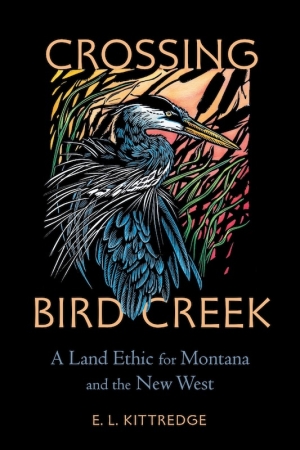
Crossing Bird Creek: A Land Ethic for Montana and the New West
“The future of the northern Great Plains, ‘Flyover Country’ to some, and ‘Next Year Country’ to its farming and ranching stewards, will be shaped by our ability as a society to truly understand its social, agricultural, and ecological history and communities. The rich prose of this treatise is far deeper and broader than the namesake ‘humble’ creek of the title.
This book about place and our relationships to it finds its center in generations fully lived on a west-central Montana ranch where both the land and its animals are ‘kin.’ Rich in metaphor, it stitches together history, memories, stories, and the wisdom of elders, authors, and philosophers. It asks of us that we (individually and collectively) recognize and inhabit our physical, cultural and imaginary landscapes and ‘inscapes’ to become aware, open, alive, whole. Perhaps in so doing, we may heal communities. Such healing is certainly needed in these times, across all fences (both real and metaphorical).”
—Daniel Casey, retired coordinator of the Northern Great Plains Joint Venture
“Crossing Bird Creek is an expansive and heartfelt reflection on the evolution of rural life in the American West and the interplay of landscape and culture in the formation of the Montana spirit.”
—Kimberly Gibson, Inclusive Innovation Postdoctoral Scholar at the Experimental Smart Farm at the University of California, Merced
“Crossing Bird Creek, appropriately, ranges wide. E. L. Kittredge leads the reader on a thoughtful and remarkably comprehensive meander through a place so dear and so much itself that it cannot help but to be made lovely to us through all of its history (kind and bitter both), ‘drifting,’ as she writes, ‘through time and space.’ This book is exemplary for its clarity in demonstrating the knowledge, connection, and submission required of a people who aim to settle in a wild place, no matter where on the globe that particular place may be. A beautiful and deeply humane dispatch on horseback from the high, hard West.”
—Ben Aguilar, director of operations for the Berry Center in Henry County, Kentucky
Book description
Bird Creek flows unmarked through E. L. Kittredge’s Montana ranch, making discovery difficult for even the most dedicated traveler. The creek once appeared on maps as a thin line, barely visible in a maze of county roads. Now, like the creek itself going underground in drought, that line has disappeared from official Montana state guidebooks, omitted to simplify the map for tourists wedded to interstate highway travel.
Defiant of the mapmaker’s current reality, the creek still runs, even if sometimes unseen. But the creek has whispered its secrets to Kittredge and her family for decades, and she seeks larger meaning from it, in all its fraught complexity. Using the creek as her literary lens, Kittredge grounds her essays in hope for a “better year next year.” As she explores an increasingly contested West, one where new settlers encounter both acceptance and deep resentment from those who came before, she advocates adapting to new ways of seeing, knowing, and being—all vital for a sense of belonging and place.
E. L. Kittredge lives and works on her family ranch. She founded My Artrepreneur Program, which, over two decades, has helped artists across the nation build sustainable businesses in art. Kittredge continues to advocate for the folk arts, along with cultural awareness and preservation. She is the author of Artrepreneurship: Sustaining the Creative Life.
Contact
Sarah Kee, Publicity Assistant, skee2@unl.edu Marketing Department, mpress@unl.edu
1225 L Street, Suite 200, Lincoln, NE 68508 | 402.472.3581 | nebraskapress.unl.edu

Artrepreneurship: Sustaining the Creative Life
Guidebook for the My Artrepreneur Program course in helping creative minds how to build a sustainable life doing what they love.

The Weight of the Drop
A novel in submission. A genre bending historical fiction of an early gold camp and two women who lose everything, acquire a vast fortune, and embark on a quest for justice against those who wronged them. But the story has lived on and is replayed in the lives of two women in a small rural town tied to boot-legging, on the eve of the Great Depression.
A Bird Creek Imprint
A Bird Creek Imprint
Thanks for visiting this little corner of “Next Year Country” in the Upper Great Plains. Here’s where we gather and sort our thoughts about life along Bird Creek.
Now that you are here, let’s stay in touch!
If you wish, do follow us on Facebook or Instagram, what some in the past may have called “A Half-Penny Post.”
If you want to read longer essays about what I have been working on/creating, visit “Bird Creek Letters” on Substack.
The topics touch on the wild and working land, culture, creativity. And of course, learning, writing, and the spaces in between.
Filling out the CONTACT FORM makes sure we haven’t overlooked you and your interest. (We promise not to share your information).