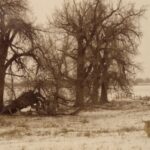
[Note: The photo, take near the town of Wolf Creek between 1915 and 19219, the rocky walls of Wolf Creek Canyon and Prickly Pear Creek. The railroad tracks (still in place) run parallel to the creek, and a single automobile travels on the dirt road grade, above the railroad tracks. Power and telephone lines track with the railroad and the road. (This photo from: https://mhs.mt.gov/Research/services/repros/photodigital or contact Montana Historical Society Photograph Archives, photoarchives@mt.gov.]
Recently, I received a late-night, highly frustrated text from a good friend who had just returned from a business meeting, about ninety miles from his home, only “a crow’s hop” away in the parlance of another time.
He had just traveled the highway along the Missouri River that cuts its way through parts of a Palaeozoic volcano. Named Wolf Creek Canyon on maps, locals call it “The Canyon.” The road pushes between towering rock walls that seem to lean in, demanding more space on one edge while on the other brink, mere feet away, an impatient Missouri River shoves back, holding its line.
“You’ll never believe what I saw,” the text began.
He must have seen a herd of mountain sheep lounging beside the highway. He is a sensitive soul and loves the outdoors.
But maybe it was a dead deer left lying on the edge of the road. That’s a common sight, especially during hunting season. This hunter who butchers his kill wouldn’t be horrified.
Or perhaps someone hadn’t secured their garbage as they drove to the dump. Our high winds hardly make that unusual.
All wrong.
He continued, “It’s absolutely sickening.”
Let’s see, I thought. Last week, a young man lost control of his pickup and was killed in the Canyon. Did my friend see that? Or maybe he saw some semi-truck “schmuck” a deer. Maybe the road crews were installing more illuminated arrows to signal curves.
Again, no, no, and no. But why the text?
“I can’t believe that someone is building what looks like a three-story house right on top of the highest point of the rocks near where I always have fished. The cost of just building the road up there would buy a regular house. Why did he have to build right there? Right on the edge. Like right in my face. It’s not done yet, and it already sticks out like a sore thumb.”
Before I could respond, he continued, “But what bothers me most is that I can’t figure out why? Why am I so upset? It isn’t like there aren’t thousands of other acres close by that aren’t untouched. It’s not like this is where I played when I was a kid. Besides, there are other houses lining the river. Tell me, why does this ONE bother me?”
That’s a question that has drawn my attention to research and write about in my forthcoming book of essays CROSSING BIRD CREEK: A LAND ETHIC FOR MONTANA AND THE NEW WEST. The release is scheduled for 2026.
A sense of place grows from within, mixed with the contex without, at the same time living both within us and cued by our physical and cultural contexts. It may be public, seen and claimed by all, not unlike the air we breath. Or it may be hidden and protected deep in our innermost emotions. In so many ways it is tenacious, calling us, controlling us, but at the same time being terribly tender and fragile as our private place where we feel we fit.
Some may say the definition is simple. But I have found that in the simple lies the complex.
The ranch where I grew up lies near where the Missouri breaks out of the Canyon into the open space of the upper Great Plains. My family has been here since before the politicians fought for control, negotiated boundaries, and debated what to name the ground.
I knew the Canyon before it was “discovered.” Before the Interstate cut through hayfields. Before drive-time diminished between the state capital and one of two designated urban areas in the state. Before Hollywood filmed “The Untouchables” with stars like Sean Connery, Robert DeNiro, Kevin Costner, and Andy Garcia. Before houses crowded the river’s edge or flotillas of floaters’ rafts competed for space with the fly-fishermen.
Then, no buildings teetered on top of sheer rock walls. The road passed along hayfields and pastures, by farms, through two small towns, and along an active train track carrying passengers to other connections.
Having seen that change, I understand my friends’ sorrow over his loss of an “unbounded horizon.” Even though not raised here, he had found a place of comfort. After twenty years, he had begun to root, but now a deep nerve signaled.
I understand that feeling. Although the Canyon remains part of my “home turf’s” viewshed, I still feel a jar, a spasm of loss each time I drive the route. Although a core of my “sense of place” remains, the edges are corroded, lost.
A sense of place brought me home to Montana. In that realm authors like Wallace Stegner and historians like K. Ross Toole worked. It shaped my doctoral research and focused my writing about horizon lines meet learning and creativity in the culture of the land, where families have spent generations.
Some write that Eudora Welty coined the phrase “sense of place.” In On Writing, she emphasizes that a writer must have a “starting point” and understand it, feel we fit, be at ease on the ground we stand. The truth told of that relationship defines, in Welty’s view, the verity of why she writes.
Delving deep to answer the why can help us learn to step more lightly on the land and with each other. In our now, that can be a test. Perhaps unwinding the complexities of our own “sense of place” can help.
E.L. Kittredge ©2026